
Beliefs Moving Mountains
- Aug 6, 2025
- 5 min read
Updated: Aug 18, 2025
How Leaders Transcend Limiting Beliefs To Build the Impossible
There’s a phrase you’ve likely heard: “If you believe, you can move mountains.” It sounds poetic. Perhaps naïve. But for those of us working at the edge of leadership, transformation, or human performance, we know something deeper: Belief is not soft. It determines what gets built, who follows, and whether the impossible becomes possible.
The challenge is, most leaders don’t realise that they are not leading their beliefs, their beliefs are leading them.
What Are Beliefs, Really?
At a basic level, a belief is a mental model: a repeated pattern of thought we treat as truth.
But more accurately, beliefs are the inner blueprint from which all action, risk, decision-making, and leadership behaviour arises. They can be:
Inherited (“Work must be hard to be valuable.”)
Formed from experience (“People like me don’t get promoted.”)
Cultural (“We must always be the best.”)
Self-authored (“I can learn anything I set my mind to.”)
Beliefs are filters, not facts. But when left unexamined, they become laws that silently govern a leader’s world. However, even the most talented leaders sabotage progress if they're trapped in unconscious narratives like:
“If I slow down, I’ll lose respect.”
“I need to have all the answers.”
“I’m not ready yet.”
“This is just the way it’s always been.”
These are not character flaws. They are cognitive distortions (Beck, 1976) — inherited or self-reinforced beliefs that create emotional noise and blind spots in decision-making. These patterns as deep emotional maps formed early in life, which get triggered in high-stakes environments like leadership transitions or public scrutiny (Young et al., 2003).
Left unchecked, a single limiting belief can become the invisible glass ceiling on an entire team or organisation.
Belief Is the Engine Behind Behaviour
Carol Dweck’s research on the growth mindset (2006) radically shifted how we understand performance. Her work shows that the belief that abilities can develop leads to more innovation, resilience, and engagement — in both individuals and cultures.
In business, this principle scales. If you believe:
Change is possible → you’ll lead transformation.
People are trustworthy → you’ll build autonomy.
Failure is learning → you’ll create innovation loops.
Belief shapes posture. Posture shapes behaviour. Behaviour shapes results. In essence, belief is behavioural gravity. It quietly pulls your world into the shape of your assumptions. Here is how beliefs shape reality:
Belief Identifies the Inner Terrain: Exceptional leaders learn to hear the voice beneath the strategy. This is the internal monologue that whispers doubt, urgency, or resignation. They ask: What belief is fueling this behaviour? And: Is it still serving the vision? They listen for inherited systems — parental, cultural, organisational — and start to edit their inner script.
They Replace Old Beliefs with Coherent Ones: Belief-shifting requires awareness, inquiry, replacement and repetition. Example: Old belief: “I must work harder than everyone to be enough.” New belief: “I create more impact when I honour my energy and focus.”
They Lead From the Future: magnetic leaders (Scharmer, 2009) don’t just work toward a better future. They embody it now. They align beliefs with their future identity, and act as if that version is already in the room. This creates congruence, confidence, and coherence — and others feel it.
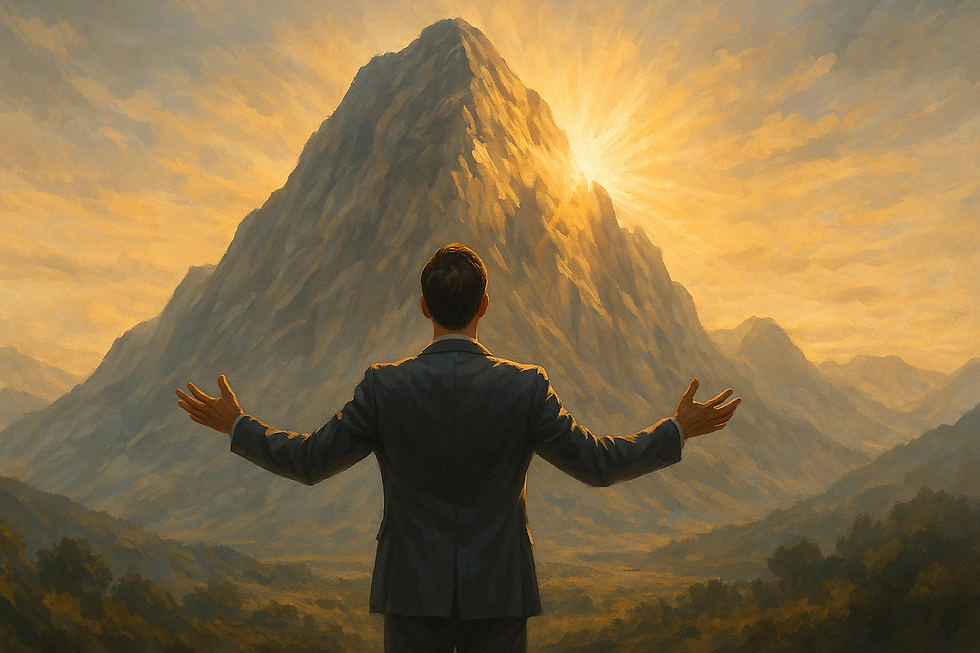
The mountain doesn’t move because of force. It moves because the leader no longer believes it’s immovable.
The Mountain Is Not Out There
Every great leader faces mountains: A failing quarter. A cultural ceiling. A personal crisis. A collapsing plan. But the mountain is not the obstacle. The belief about the mountain is.
When you shift what you believe is possible, tolerable, or true. You shift what the organisation becomes capable of. So yes: If you believe, you can move mountains.
But more accurately: If you believe, you become the kind of leader who no longer sees the mountain as fixed. And from there, nothing is impossible. These challenges are real. They have data, timelines, and consequences. But what determines whether they become breakdowns or breakthroughs is not the size of the problem, it’s the perception and belief system of the leader facing it. This is the managerial meaning of the ancient principle: “As within, so without.”
The obstacle is not just out there. It is also in here. The way the leader relates to it in here will impact how it shows up out there.
When a leader believes:
“This is insurmountable,” the team feels discouraged and contracts.
“This is solvable,” the team looks for options.
“This is an opportunity,” the team innovates.
Beliefs aren't private thoughts. In leadership, they are contagious fields. They unconsciously set tone, limit creativity, or unlock courage across the system. That’s why culture often changes not through policy, but through posture. Let’s reframe the mountain.
A failing quarter is not the problem. Believing you are powerless to affect it is.
A resistant team is not the problem. Believing their resistance means rejection of you is.
A chaotic restructure is not the problem. Believing you must hold it all together alone is.
You don’t need to overpower the mountain. You need to upgrade the belief that sees it as immovable.
The mountain always appears external. But it is also a mirror reflecting back the edge of your current beliefs. The moment you shift what you believe is possible, tolerable, or true, you shift what the organisation is capable of creating. So yes, if you believe, you can move mountains.
Process To Redefine Beliefs
Vishen Lakhiani, owner of Midvalley talks about creating power questions that redefine your beliefs. Many times I got stuck with weight loss for instance and I would ask 'Why am I stuck?' Vishen says that when you ask that question your subconscious mind, will try to answer that questions giving you all the reasons for it.
He then suggests to create questions that empower the subconscious. For instance you might ask, 'Why do I have an athlete's body?' Now I do not have that at the moment. But asking this would start putting my mind into:
Installing the belief that it is possible.
Defining the identity aimed for.
Start looking for reasons to move towards the goal.
Start setting the mind as if what is asked is possible and inevitable.
Look at moving the mind from where I am to where I want to be.
References
Beck, A. T. (1976). Cognitive therapy and the emotional disorders. Penguin.
Dweck, C. S. (2006). Mindset: The new psychology of success. Random House.
Scharmer, O. (2009). Theory U: Leading from the future as it emerges. Berrett-Koehler.
Young, J. E., Klosko, J. S., & Weishaar, M. E. (2003). Schema therapy: A practitioner’s guide. Guilford Press.


Comments