
Body Intelligence
- Jul 21, 2025
- 4 min read
Updated: Jul 23, 2025
How Leaders Reclaim Their Body
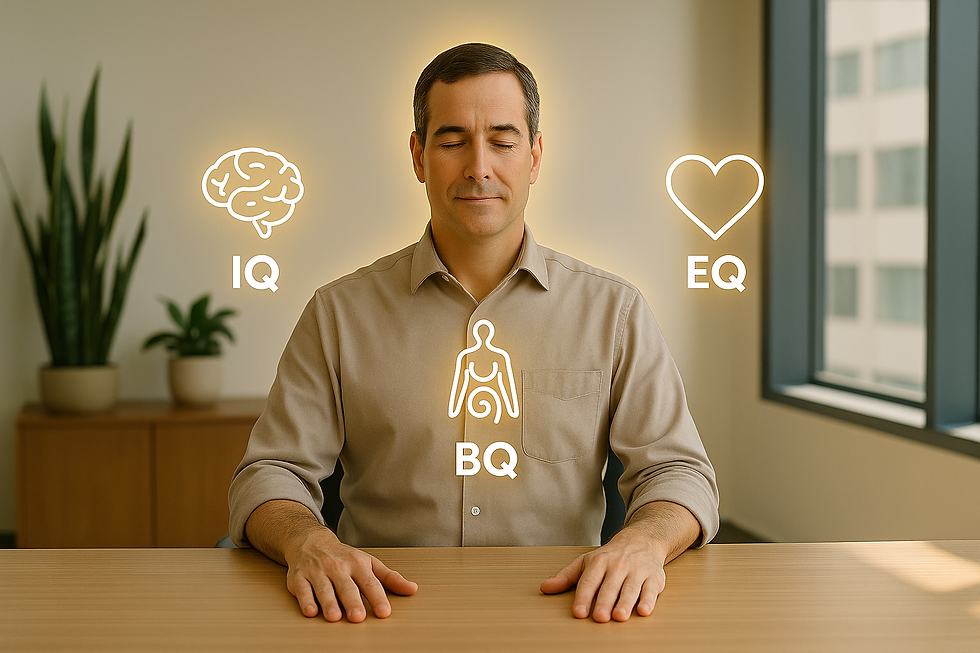
In the corridors of strategy and decision-making, we often invite two guests to the table: intelligence (IQ) and emotional awareness (EQ). But there’s a third player—quiet, constant, and powerful—who rarely gets a seat: body intelligence (BQ). Without the body and our health, we are dead.
“The mind may plot the strategy, but the body delivers the result.”
What Is Body Intelligence (BQ)?
Think of the body as your silent partner in your leadership team. It doesn’t shout, but it signals. It doesn’t argue, but it aches. It doesn’t speak in words, but in posture, pulse, and presence. In today’s pressure-cooker of performance, many leaders are operating like decapitated chickens: razor-sharp minds, emotionally literate hearts, but utterly disconnected from the wisdom below the neck.
Body Intelligence (BQ) is your capacity to sense, interpret, and respond to internal physical signals—like muscle tension, heart rate, breathing, or gut sensations—in ways that support wise and sustainable action. While IQ helps us think and EQ helps us feel, BQ helps us know—instinctively and immediately—what is safe, aligned, or out of integrity. This isn’t woo-woo. It’s neurobiology.
Body Awareness For Performance
When under constant stress—emails pinging, deadlines looming, people-pleasing your nervous system stays on alert like a faulty alarm bell. You feel constantly “on”, yet increasingly depleted. It gives you the illusion that you are working faster, better and outperforming everyone. Yet you are like a car on two wheels, doing unsustainable tricks.
Studies show that leaders with low body awareness are more likely to experience burnout, chronic stress, and poor decision-making (Craig, 2015). By contrast, greater body awareness is linked to improved resilience, emotional clarity, and ethical leadership (Mehling et al., 2011; Critchley & Garfinkel, 2017).
Applied Body Basics
Over my years as a trainer and manager I focused a lot on doing. Rarely did I look at the quality of the work and the state of my work. I would end up with heavy headaches that would bring me back to bed. My cycle was Monday to Tuesday push like mad, Wednesday down with a headache. Thursday and Friday take it slow. Saturday and Sunday do nothing.
I gained weight with this cycle, that together with pushing myself to lose weight, spiralled me in to greater unhealth. I got help and what I realised was that what I needed to reverse my approach of eating, pushing and resting. My system returned to normal and I started having more energy, less headaches and greater optimism. Body awareness gave me my life back and reignited my motivated and energy through:
Better Decision-Making: BQ helps you access what Goleman (1995) calls the “somatic marker”—the physical ‘gut feel’ that precedes conscious reasoning. You’ll often feel a decision before you can explain it.
Presence & Influence: A grounded body communicates calm and credibility. The body broadcasts safety—or threat—far before you speak. Teams read your posture, not just your policies.
Burnout Prevention: Noticing when your breath is shallow or your body is in “fight mode” allows for micro-interventions—a walk, a stretch, a breath—that prevent long-term depletion.
Modern Leaders: Riders With Sick Horses
Imagine the leader as a rider and the body as a horse. Most leaders today try to gallop through change with a limping horse. They override signals, ignore pain, and push through fatigue. But a wise rider listens to the rhythm, cares for the animal, and works with it—not against it. When rider and horse are in sync, they don’t just perform—they inspire.
Your body has been whispering to you for years. About fatigue. About people. About direction. The good news? It hasn’t given up. You can start listening again. The body isn’t a barrier to high performance. It’s the source of it. A chronically stressed body cannot sustain clear thinking, emotional regulation, or strategic foresight—core competencies in leadership.
Physical wellbeing isn’t a luxury; it’s infrastructure. When sleep, nutrition, movement, and recovery are compromised, leaders operate from reactivity rather than vision. The healthiest leaders don’t just manage crises—they model sustainability, inspiring teams by how they live, not just what they say. Here are 3 practical steps to achieving it:
Body Check-ins: Set 3 alarms a day to pause and ask: “What’s happening in my body right now?” Use the HEAD → HEART → GUT scan.
Let Your Body Breathe: Before high-stakes moments, plant your feet, soften your jaw, and deepen your breath. Come back to the body before you speak.
Reflection on experience: Track sensations during key leadership events. What were you feeling in your body when you made that great (or poor) decision?
References
Craig, A. D. (2015). How Do You Feel?: An Interoceptive Moment with Your Neurobiological Self. Princeton University Press.
Mehling, W. E., et al. (2011). Body awareness: a phenomenological inquiry into the common ground of mind-body therapies. Philosophy, Ethics, and Humanities in Medicine, 6(1), 6.
Critchley, H. D., & Garfinkel, S. N. (2017). Interoception and emotion. Current Opinion in Psychology, 17, 7–14.
Goleman, D. (1995). Emotional Intelligence. Bantam Books.


Comments