
Body Coherence
- Jul 21, 2025
- 4 min read
Updated: Jul 23, 2025
Tap Into The Wisdom Of Your Body
In high-stakes boardrooms, the phrase “trust your gut” gets thrown around like a motivational cliché. But what if your gut isn’t just poetic — what if it’s neurological?
Modern leadership loves data, dashboards, and deductive logic. But beneath every strategic move, every risky leap, and every brilliant hire, there’s often something less tangible: a knowing that logic alone can’t explain.
"I don’t know why, but it just felt wrong." Every great leader, at some critical point in their career.

Enter your Second Brain
Your gut — yes, your literal digestive tract — contains over 100 million neurons. This complex network, known as the enteric nervous system, is so intricate it’s often called the “second brain” (Gershon, 1998). This system isn’t just digesting food. It’s digesting experience.
It communicates with your central nervous system through the vagus nerve, forming part of the gut-brain axis — a fast-moving feedback loop between body, emotion, and cognition. This system plays a key role in intuition, emotional regulation, and threat detection (Mayer et al., 2015). In practical terms? When a new hire ticks every box on paper, but something feels off. That’s not indecision. That’s somatic intelligence at work.
.
Gut Instinct ≠ Impulsivity
As a therapist-coach working with executives, I often see leaders wrestling between what their gut tells them and what the spreadsheet says. They’ve been trained to distrust the body — to prioritise cognitive logic and suppress physical sensation. But intuition is not the enemy of strategy. It’s often the precondition for clarity.
Let’s take Marisa, a COO in a fast-scaling tech firm. She described feeling “weirdly nauseous” in a meeting about a merger. She pushed it aside—“It’s probably just the coffee”—until weeks later, the deal unraveled due to a cultural mismatch she sensed but ignored. Does this mean we rely on gut only? No. It means that the gut invites a question. To trust it means to listen and see if there is any veracity in it. How can we work with this:
Pause Before the Pitch: Before making a decision, pause. Bring attention to the belly. Ask: Does this feel expansive or contracted?
Ask Questions: when something feels off or right, check why you are getting this information.
Translate Gut Into Logic: your gut is not gospel. It is an invitation. Once a question arises, try to dig deeper and see if your feeling has a logical reasoning.
Track Before & After You Act: Keep a log of your physical sensations before key choices. Over time, you’ll see patterns in your “gut data” that rival any spreadsheet.
Risk & Experiment: start with small things and see what arises. Track it and see. See how it works for you over time. Remember that this is not about getting what you want but about getting the best for your and your organisation.
3. What Is Body Coherence?
Cognitive overload is the curse of the modern manager. But intuition lives in the spaces beneath cognition. It arrives quietly, through a felt sense. Tuning into your gut doesn’t mean abandoning logic — it means letting logic be guided by grounded knowing.
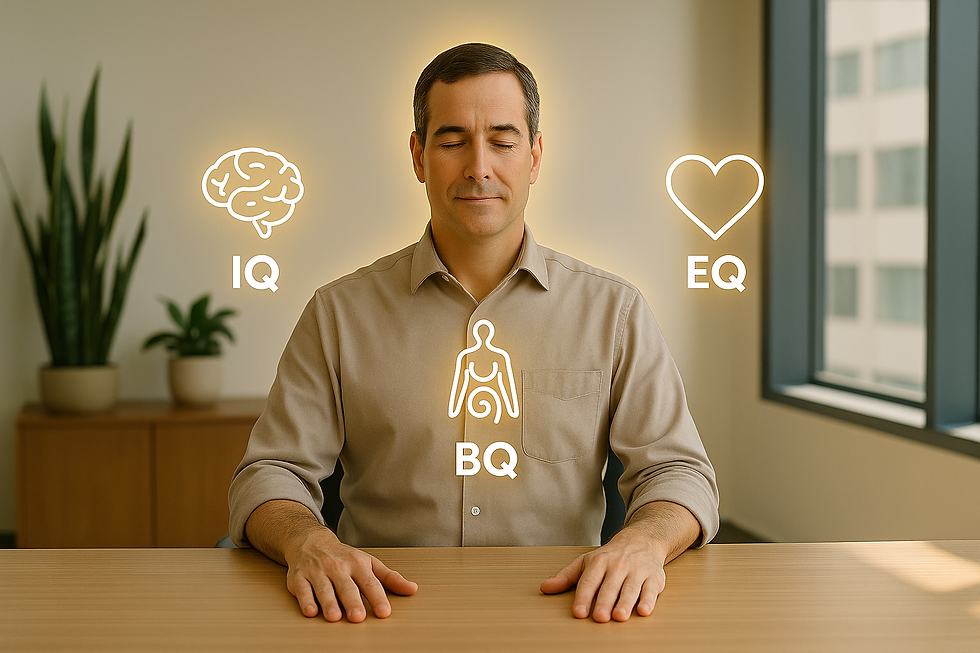
Because in the end, leadership isn’t about having all the answers. It’s about knowing when something is true—even before it can be proven. Hence what we are trying to achieve is to link gut with head and heart. A decision is aligned when there is body coherence or:
The head understands it
The heart supports it
The gut settles with it
If one feels off, it's a signal to slow down — not stop, but sense. When trained and applied well this will help you to achieve:
Enhanced decision-making: coherent leaders think clearly under pressure. They integrate logic with emotional and instinctual insight — reducing decision fatigue and analysis paralysis.
Team Trust: Teams sense when a leader is “off.” Misalignment shows up as inconsistent communication, forced optimism, or over-compensation. Coherence creates congruence — when your words, tone, and energy match.
Stress Regulation: Coherence supports balance. Studies by the HeartMath Institute show that heart coherence improves hormonal balance, immunity, and cognitive function (McCraty et al., 2009).
Practical Tool: The Coherence Check-In
Coherence isn’t fluff. It’s strategy — embodied. The future of leadership doesn’t belong to those who simply think harder. It belongs to those who listen deeper — to the subtle, powerful interplay between gut, heart, and brain. When aligned, you don’t just lead from the front — you lead from within. Think of your leadership self as a ship.
The brain is the captain — analysing, commanding, steering.
The heart is the first mate — gauging morale, guiding with purpose.
The gut is the navigator — sensing the unseen currents and hidden reefs.
When these three work together, the ship moves swiftly, wisely, and with direction.
But when one dominates — or is ignored — you risk veering off course or running aground. Before a major decision or conversation, ask:
🧠 Head: Does this make sense?
❤️ Heart: Do I care about this? Does it align with my values?
🌀 Gut: Do I feel safe and grounded with this choice?
If all three centers give a yes — move forward. If one hesitates — explore. If all three say no — pause. This three-centre scan creates a body-based leadership compass. It's fast, reliable, and deeply human.
References
Gershon, M. D. (1998). The Second Brain: A Groundbreaking New Understanding of Nervous Disorders of the Stomach and Intestine. HarperCollins.
Mayer, E. A., Tillisch, K., & Gupta, A. (2015). Gut/brain axis and the microbiota. The Journal of Clinical Investigation, 125(3), 926–938.
Goleman, D. (1995). Emotional Intelligence: Why It Can Matter More Than IQ. Bantam Books.
Comments